Harry and Arabella Huntington and the Gilded Age in Los Angeles
Dennis Carr, Huntington Library, Art Museum, and Botanical Garden

Thomas Gainsborough (British, 1727-1788), The Blue Boy, 1770. Oil on canvas, 70 5/8 × 48 3/4 × 1 in. (179.4 × 123.8 × 2.5 cm). The Huntington.

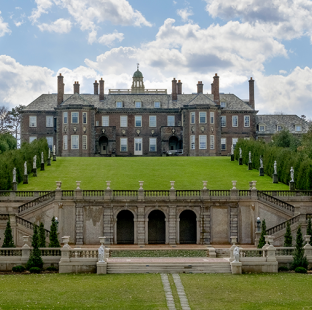
The south facade of the Huntington Art Gallery with red aloes and cycads. The Huntington. Linnea Stephan photo.

West end of the Library of the Huntington residence, c. 1937. The Huntington

Thornton Portrait Gallery, The Huntington. John Sullivan photo.

Worsham-Rockefeller Dressing Room installed at The Metropolitan Museum of Art, George A. Schastey & Co., New York, 1881–82, Gift of the City of New York, 2008.
Henry E. and Arabella Huntington were among early twentieth century America’s wealthiest couples. Flush with railroad money, along with Stanford, Crocker, and Hopkins, the Huntingtons — like many of their generation and status — initially collected European art and aspired to live like European aristocrats. Eventually Henry also amassed treasures of American history that range from rare copies of the Declaration of Independence to the earliest books printed in British North America.
The Huntingtons’ story also centers around the incomparable Arabella Duval Huntington. Of an unknown age and mysterious origins, she married two Huntingtons: first Collis then Henry. She used her incredible eye for art and great fortune to become one of the most remarkable collectors in turn-of-the-century America. She is the inspiration for The Gilded Age television series character Mrs. Chamberlain, the spectacularly rich woman with a mysterious background struggling to break into New York high society. Collis built Arabella one of Fifth Avenue's largest mansions, although she preferred her sprawling chateaux near Paris.
In 1913 Arabella married Henry E. Huntington and, for part of the year, the couple lived at their San Marino estate near Pasadena where they amassed acclaimed library, art, and botanical collections. Of special interest were their British grand manner portraits, the first such Old Masters collection in Los Angeles. They later added renowned European paintings and decorative arts to their holdings.
In 1919 the Huntingtons transformed their private estate into the public institution now known as The Huntington Library, Art Museum, and Botanical Gardens. Today, The Huntington contains 13 million items. Its 100 acres of cultivated gardens feature thousands of plant species and an astonishing array of European, Chinese, and Japanese garden architecture. Arabella’s superb art collections are now spread across such institutions as the Metropolitan Museum of Art, the de Young Museum, and of course, The Huntington.
This talk explores the Huntingtons' extraordinary civic and cultural contributions to the city of Los Angeles, and their legacy as Gilded Age collectors. Dennis Carr is the Virginia Steele Scott Chief Curator of American Art at The Huntington. He has curated or co-curated such exhibitions at The Huntington as Sargent Claude Johnson; Gee’s Bend: Shared Legacy; Don Bachardy: A Life in Portraits; and Radical Histories: Chicano Prints from the Smithsonian American Art Museum, as well as Borderlands, the major reinstallation of the galleries of American Art. Prior to joining The Huntington in 2020, he was the Carolyn and Peter Lynch Curator of American Decorative Arts and Sculpture at the Museum of Fine Arts, Boston for thirteen years. There, he worked to expand the collection of American and Latin American art and was a co-curator of the award-winning, 53-gallery Art of the Americas Wing in 2010. His exhibitions at the MFA include the critically acclaimed Made in the Americas: The New World Discovers Asia; Cecilia Vicuña: Disappeared Quipu; and Collecting Stories: Native American Art. He holds graduate degrees in the History of Art from Yale University and the Winterthur Program in Early American Culture, and was a 2019 fellow at the Center for Curatorial Leadership.